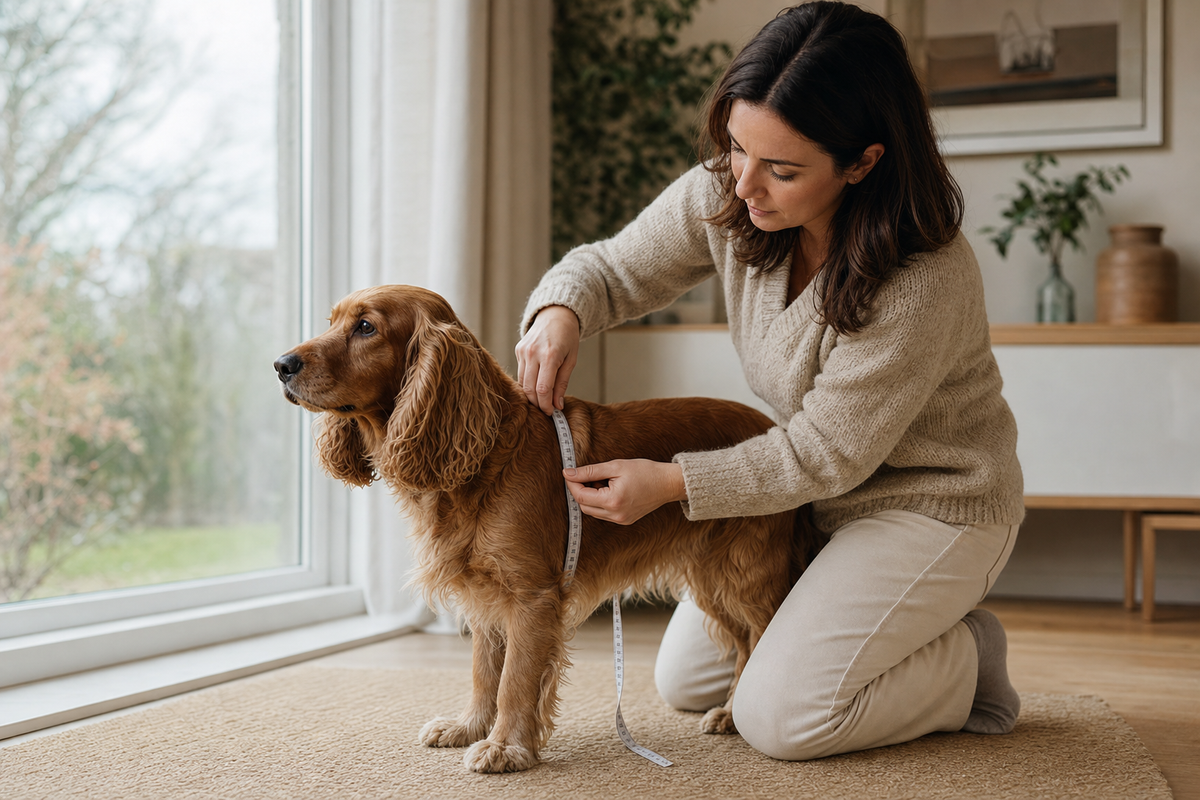
The short answer: measure your dog rather than choosing a harness from breed alone. The most useful measurement is usually the widest part of the chest, taken just behind the front legs. Depending on the harness, you may also need the lower neck measurement.
A well-fitted harness should feel secure without pressing into the armpits, restricting the shoulders or sliding around the body. This guide explains how to measure a dog for a harness at home and how to check the fit before a longer walk.
What you need
- A soft fabric measuring tape
- Your dog standing naturally on a level surface
- A few treats or another calm reward
- The size chart for the exact harness you are considering
If you do not have a fabric tape, use a piece of non-stretch string and measure it against a ruler. Do not use a rigid metal tape directly around your dog.
How to measure your dog’s chest
- Ask your dog to stand normally. Measuring while sitting or lying down can change the shape of the chest.
- Find the widest part of the ribcage. This is normally just behind the front legs, not directly inside the armpits.
- Wrap the tape around the chest. Keep it level across the back and comfortably close to the coat. Do not pull it tight.
- Record the measurement in centimetres. Measure twice to reduce the chance of an error.
- Compare it with the product’s own chart. Harness sizing is not universal, so a medium in one design may differ from a medium in another.
How to measure the lower neck
Some harnesses need a lower-neck measurement. Place the tape around the base of the neck where a harness neckline would naturally sit—lower than a collar. Again, keep the tape level and close without compressing the coat.
What if your dog falls between two sizes?
Start by checking the adjustable range and the manufacturer’s instructions. If your dog is close to the top of one size and still growing, the larger adjustable size may give more useful room. If your dog has a deep chest, narrow neck or unusual proportions, prioritise the measurement that controls the harness position and contact the retailer before ordering if the chart is unclear.
Do not simply size up by breed. Two dogs of the same breed can have very different chest shapes, coat thickness and body condition.
The fit check before your first proper walk
Once the harness is adjusted, check all of the following indoors:
- You can slide roughly two fingers beneath the straps without forcing them.
- The chest and neck straps do not press into the throat.
- The straps sit clear of the armpits and do not rub when your dog takes a few steps.
- The harness does not rotate noticeably when gentle sideways pressure is applied.
- Your dog can walk, turn, sit and lower their head naturally.
- Buckles are fully closed and loose strap ends are secured.
Blue Cross notes that a well-fitting harness can be more comfortable for some activities, while a poor fit can rub or interfere with movement. That is why the final movement check matters as much as the number on the tape. Read the Blue Cross guidance.
Common measuring mistakes
- Measuring over a thick jumper or coat: measure the dog, then check whether the harness is intended to sit above or below clothing.
- Using the collar measurement: the lower harness neckline often sits in a different place.
- Pulling the tape tightly: this can lead to a restrictive choice.
- Relying on weight alone: weight does not show chest depth or neck shape.
- Skipping the recheck: puppies, young dogs and dogs whose weight changes should be measured again.
When should you recheck the fit?
Recheck the adjustment after the first short walk, after washing the harness and whenever your dog’s body condition or coat changes. Growing dogs need more frequent checks. Look for rubbing, hair loss, reluctance to move or a harness that has begun to twist.
The RSPCA also recommends checking walking equipment regularly and using visible or reflective equipment when light levels are poor. See the RSPCA’s dog-walking advice.
Ready to compare colours and sizes?
Explore Novara’s Reflective Dog Harnesses and use the measurements on the individual product page before choosing. If your dog sits between sizes or has an unusual build, contact us before ordering.

Leave a comment
This site is protected by hCaptcha and the hCaptcha Privacy Policy and Terms of Service apply.